A Is for Autism
When Something Becomes Everything, Everything Becomes Nothing.

TL;DR — This essay is about what happens when a name and category becomes too successful. “Autism” is increasingly made to carry a very large range of neurocomputational differences in children and young adults; ADHD often performs a similar role (That’s for another time). When something becomes everything, everything becomes nothing. If autism is used to name forms of human heterogeneity that fall outside its own descriptors, the label loses the resolution and importance needed to tell us which mechanisms are operating in an individual person. Diagnostic categories are often a shorthand for access to services, communication about differences and experiences and inform clinical decisions. Administrative usefulness, however, does not create explanatory content. Zero plus zero is still zero. The alternative is to return to first principles: decompose the label into testable differences in precision, inference, learning and action. The payoff is practical as well as scientific; more precise assessment, better self-and-other understanding and better interventions and support.
Summary for teachers
An autism diagnosis can describe a recurring pattern and may support access to services, but it cannot explain how that pattern is being generated in this pupil, in this situation. The essay therefore asks teachers not to move directly from a label to an explanation, or from behavioural signals to an assumed inner state and off the shelf diagnosis. Begin with what can be observed and construct more than one possible account of how perception, prediction, learning, bodily regulation and action may be interacting. A useful account must distinguish itself from alternatives: it should tell you what would change if it were correct. Alter one relevant condition, observe the result and revise the account. Educational support should follow from the mechanism for which there is evidence, not from a generic idea of what “autistic pupils need”.
Summary for parents
An autism diagnosis can be useful, but it cannot explain your child. It tells you that a pattern resembles a category; it does not tell you what is producing that pattern in this child, today. Do not assume that rocking, withdrawing, repeating, distress or silence always has the same cause or meaning. Begin with what you can observe: what changed, what information was available, what the child did and what changed after they acted. Keep bodily causes and the child’s own account in view, and consider more than one possible explanation. Then ask what each explanation predicts, change one relevant part of the situation and see what happens. If the predicted difference does not occur, revise the explanation. The aim is neither to explain everything as “autism” nor to make the child appear less autistic. It is to understand this person well enough to protect their agency, learning and wellbeing.
A note about diagnosis. This is not an argument against diagnosis per se or access to support. It is an argument against asking a diagnostic category to explain the mechanisms producing a particular person’s experience and actions.
How to use this article. Parents and teachers can begin with the two summaries above and move directly to the practical sections near the end. Readers who want the theory and evidence can continue through the central argument.
The essay at a glance
This organiser maps the central ideas and how they connect. You can return to it as you read.
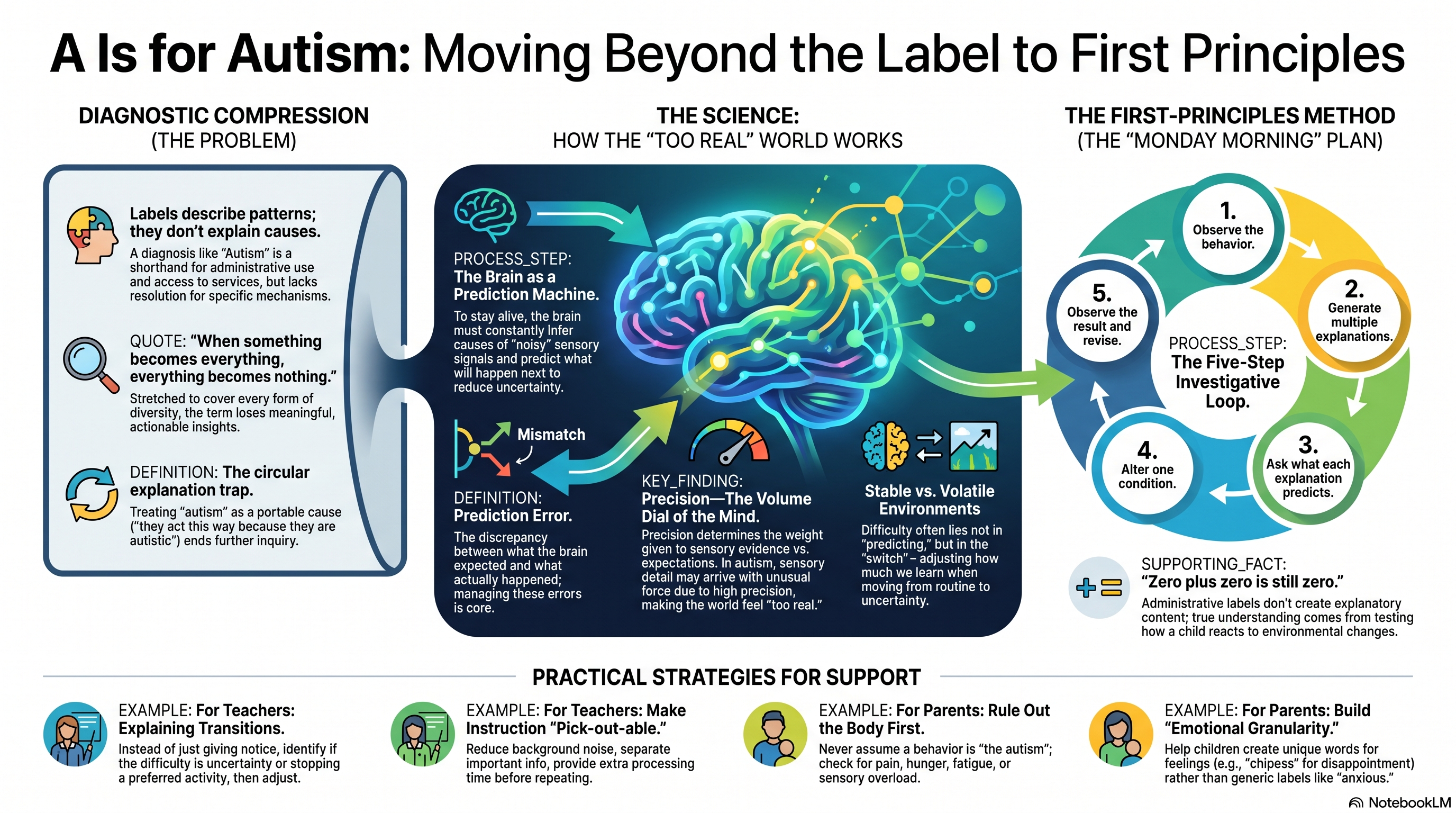
Prefer a visual overview?
This short NotebookLM-generated video gives a quick visual overview of the essay’s central argument and practical implications.
He was probably 9 years old, outside the library, rocking back and forth. The stereotyped behaviours were a hallmark of his in the community.
She was 5, in a nursery, highly focused on the toys she was playing with, and highly distressed when anyone interfered.
He was 15, at a special school. Upon seeing him, I noticed a glaring and striking difference. His look conveyed to me a window that couldn’t be opened. A world I couldn’t see, a key I couldn’t give.
I am not presenting these descriptions as truths about the children. I am showing how, many moons ago, I had learned to see them. As an educational psychologist, I interpreted observations like these through the prototype of autism. Once the signs appeared to fit the diagnostic criteria, the category became a way of understanding the child’s experience.
My attempt to explain behaviour from first principles is therefore in constant tension with broad, low-resolution concepts—especially when one concept is expected to contain the complexity within a single person.
I have no quarrel with categories of furniture—or food, for that matter; I love my food. The problem begins when we compress human differences into categories that do not explain how those differences arise.
One experience gave me a front-row view of how widely the autism category was being stretched. During my doctoral research, all seven pupils I saw had been formally diagnosed with autism. The patterns I observed did not fit the descriptors cleanly or in the same way. This was not a retrospective diagnostic review, and I am not claiming that their diagnoses were invalid. The narrower point is that the shared label did not explain why the pupils differed so markedly. What, then, are the descriptors?
Let us answer that question literally before trying to answer it scientifically.
The descriptors
DSM-5-TR does not define autism by a cause, a biomarker or a computational mechanism. It defines it by the co-occurrence of observable features. All three forms of persistent difference in social communication and social interaction must be present: differences in social-emotional reciprocity; in the use and understanding of non-verbal communication; and in developing, maintaining and understanding relationships.
At least two of four restricted or repetitive patterns must also be present: repetitive movements, speech or use of objects; insistence on sameness, routines or ritualised behaviour; highly restricted or unusually intense interests; and hyper- or hyporeactivity to sensory input, or unusual interest in sensory aspects of the environment. The pattern must arise in the early developmental period, although it may be evidenced only in certain non-optimal contexts or may be concealed by specific strategies. It must have a significant effect on everyday functioning, and it must not be better explained by intellectual disability or global developmental delay. ICD-11 uses almost the same two-domain architecture, while allowing for differences in language and intellectual development.1
There they are. The descriptors are a conjunction of behaviours plus rules about onset and impact.
Those descriptors may support reliable clinical decisions. They are not yet an explanation, and the category cannot acquire explanatory content simply by being applied more often and more widely. The problem is not just that autism covers several domains of functioning. It is that the label is increasingly made to absorb forms of human heterogeneity (diversity!) that fall outside the descriptors supposed to delimit it. The manual does not tell us why rocking, distress at change, sensory uncertainty or precision, a deep interest and difficulty coarse-graining2 (simplifying) volatile social signals to update a model of an interaction should belong to one natural kind. It does not tell us whether the same behaviour has the same generative cause in two people.
A diagnostic category compresses to communicate; first principles must decompress to explain.
That compression has also accumulated a popular folk theory of autism. Terms such as sensory overload, dysregulation, masking, demand avoidance, rigidity and communication difference refer to something real, but they are increasingly treated as portable causes: the child acts this way because they are autistic, and the behaviour is then offered as evidence of autism. The explanation closes into a circle. Repetition across professional language, services and popular culture gives the package familiarity and authority, but familiarity is not explanatory validity.
When the world becomes ‘too real’: what parents and teachers might notice
Let me bring this back into a classroom. A light hums. A chair scrapes. A face changes. Someone looks. The timetable changes too. To the teacher, perhaps, one thing happened. The child, however, may be trying to follow what someone is saying while the chair scrapes, another person’s expression changes and the timetable no longer matches what they expected. At the same time, the child has to work out what changed, what another person meant and what to do next. The behaviour we see may be one consequence of having to solve all these problems together. Put simply, several mismatches between what was expected and what is happening may all continue to matter at once. The technical account of that possibility comes next.
Does this mean that autistic children cannot learn patterns? Not at all. Many can learn them perfectly well, and sometimes exceptionally well, when the pattern is reliable, the exposure is long enough and the relevant cue is clear. It’s almost like taking a photo, isn’t it? The useful question for a parent or teacher is not “Can this child predict?” It is: “Under which conditions do we observe slower initiation, more errors, more repetitive action or longer recovery?”
The question is not “Can this child predict?” The question is: “Under which conditions do initiation, accuracy, repetitive action or recovery change?”
The result may be an experience that is vivid, effortful and difficult to simplify. Sameness and repetition may make what happens next more stable. Rocking, tapping or other forms of stimming can produce familiar, self-generated sensations; a focused interest can provide patterns that are easier to learn and revisit. These actions may be adaptive before they become straining in a setting that requires frequent switching. They should not, however, be assigned a single meaning in advance. The question is what each action changes for this person.3
What could make the world feel “too real”?
Start with the problem faced by every living system. To remain alive, an organism must keep itself within a limited range of viable, bounded bodily and environmental states. It cannot wait passively for the world to disclose itself. Sensory signals are ‘noisy’ and ambiguous, so the brain must infer their hidden causes, anticipate what will happen next and act to make some futures more likely than others.
This is where several terms that are often treated as synonyms need separating. The Free Energy Principle (FEP) (please see my previous essay for more information about this theory) is a very general, normative claim about how self-organising living systems remain within characteristic states. Active inference is a framework for perception, learning and action under that principle: an organism updates its model, samples the world and acts so as to reduce uncertainty while reaching preferred outcomes. Predictive processing is the broader family of claims that brains use hierarchical generative models. Predictive coding is one proposed neural implementation, in which predictions travel down a hierarchy and prediction errors travel up it. These are not four rival theories sitting at the same level.4
Nor can autism simply be “failure to minimise prediction error”. Every viable system must manage prediction error, or things not happening according to plan. A specific account has to say which uncertainty is estimated differently, at which level of the hierarchy, in which context, over which timescale, and with what consequences for action.
The crucial variable is precision. A prediction error is the discrepancy between predicted and observed input. Precision is the inverse of uncertainty: it determines how much weight the system assigns to a prediction or to the sensory evidence that contradicts it. A prior (the expectation) is the model’s probability distribution over possible causes before the present signal is incorporated. Precision weighting therefore determines which errors alter the model and which are down-weighted as ‘noise’ or irrelevant information. It is related to attention and learning rate, although these constructs should not be collapsed into one another. If a sensory error is assigned high precision (alarm, this is important!), it captures processing and drives updating. If a prior is assigned high precision (a strong expectation), incoming variation is more readily explained under the current model. Neither setting is inherently deficient. The mechanistic question is whether precision is calibrated flexibly to context and estimated volatility—how quickly the relevant environment is changing.
The titles of two influential papers capture the dispute. Pellicano and Burr’s When the World Becomes ‘Too Real’ proposed that autistic perception may be less softened by prior expectations, allowing present sensory detail to arrive with unusual force, leaving the person to feel as if the world feels too real. Van de Cruys and colleagues’ Precise Minds in Uncertain Worlds shifted the emphasis: the difference may not be weak prediction itself, but the high and inflexible confidence—precision—given to prediction errors (mismatches between expectations and sensory evidence). In that case, too many deviations continue to require an explanation instead of being dismissed as random, unimportant variation. Later accounts add differences in context, volatility and the speed with which learning rates are changed. These proposals overlap, but they are not interchangeable.5
The empirical literature prevents us from turning this into another blanket deficit. The paper Intact Predictive Processing in Autistic Adults found that autistic adults learned a hidden probabilistic sequence as well as comparison adults. Children on the Autism Spectrum Update Their Behaviour in Response to a Volatile Environment likewise found flexible changes in learning rate. Testing Predictive Coding Theories of Autism Spectrum Disorder Using Models of Active Inference found no generic prediction failure: differences emerged in contextual precision and in adjusting learning rates. By contrast, Predictive Coding in ASD: Inflexible Weighting of Prediction Errors When Switching From Stable to Volatile Environments found a particular difficulty when a stable regime was followed by a volatile one—the switch (change/uncertainty!) mattered more than volatility itself. The 2025 atypical iterative prior updating study similarly found intact long-term prior formation but different trial-to-trial updating. A 2025 meta-analysis and a 2026 systematic review now point in the same direction: results vary by task, context and person; behavioural learning is often intact and may benefit from extended exposure and explicit cues, even when the neural route differs. The live hypothesis is therefore not “autistic people cannot predict”. It is that priors, sensory evidence, precision and learning may be calibrated differently across contexts and timescales.6
And then we come to other people, where the inferential problem becomes rather more ambitious. Objects are relatively stable. Other agents are partially observed dynamical systems: speech, gaze, posture, timing and movement are observable, but the latent variables and action policies generating them are not. A latent variable is an unobserved cause inferred from sensory evidence; a policy is a possible sequence of actions. In The Felt Presence of Other Minds, Palmer, Seth and Hohwy use counterfactual predictions—predictions of how sensory evidence would change under actions that could be taken but have not yet been taken—to distinguish rapid social coordination from slower explicit inference. On this account, the relevant autistic difference is not the absence of a single domain-specific social capacity. It is a possible difference in the depth, precision or action-conditioned richness of the generative model, such that deliberate inference may substitute for automatic perceptual presence. Put simply, another person’s intentions may not feel immediately obvious. The links between what they do, what they may be thinking and how they might respond next may need to be worked out consciously from context, rather than being grasped automatically. If experience is like a zip file (I know zip files are old, but they are still around), this means that the zip file of an individual with autism may not have compressed all the information necessary to make a good inference or guess about something.
Coordination additionally depends on timing, joint attention, imitation, learned conventions and rapid switching between models. For a parent or teacher, a delayed response, a literal question or a preference for direct language may indicate that the person needs more time or clearer information to interpret the interaction. These behaviours do not, by themselves, show how much the person values social connection. Misunderstanding may arise when two people bring different expectations, sensory tolerances and ways of interpreting words, gestures and context to the encounter. In computational terms, each is predicting the other through a differently calibrated model. The double-empathy account therefore treats misunderstanding as something that arises between people, rather than locating its cause wholly within one person. Two Heads broadens that shift from the individual brain to collective cognition. Its central question is when two people can combine evidence, communicate their confidence and correct one another—and when asymmetries in information, confidence or power make their joint understanding worse. Understanding, on this view, is not simply something one person has about another. It is something that an interaction may enable or obstruct.7
And the inferential problem does not stop at the skin. Constructed emotion extends the account to interoception. This is not the classical view of emotions, where it seems like ‘anxiety’ or ‘embarrassment’ have come down from the gods. The theory does not treat emotion words as names for biologically fixed inner entities. It treats them as learned conceptual categories used by a generative model to classify changing interoceptive and exteroceptive patterns in the service of allostasis, or the anticipatory management of bodily resources. Differences in interoceptive precision, multimodal integration, category learning or access to shared labels could therefore alter how bodily states are predicted, differentiated and reported. Alexithymia is a descriptive construct indexing difficulty identifying and describing emotional states; it is neither universal in autism nor identical to it. The alexithymia hypothesis proposes that some emotional and interoceptive differences often attributed to autism may instead be associated with co-occurring alexithymia.8
The first-principles questions are therefore computational: which bodily signals receive precision, how are they integrated with context, which category priors are available, and which regulatory policies follow? This is also where the ethical problem becomes more than a dispute about classification. If every intense, difficult-to-name or context-dependent state is read through the single category “autism”, emotional granularity collapses. Distinct states are no longer explained by distinct causes; they are absorbed into “the autism”. In computational terms, the label functions as an over-precise high-level prior: heterogeneous evidence is forced into it, and competing hypotheses are not generated or tested. The person is then understood primarily as an instance of the category rather than as an individual whose perception, bodily experience and actions still require explanation. One concept has been allowed to dominate the whole account. In Kirmayer’s terms, the diagnosis becomes an authoritative framework for sense-making: it organises ambiguous experience, but can also restrict what the person, family and professional are able to notice, narrate and imagine. That constrains inquiry rather than advancing it, and it risks becoming profoundly disrespectful to the person.
The plurality of these explanations is itself evidence for the epistemic priority of first principles. It does not mean that every account is equally good, or that disagreement proves any one theory correct. It shows that the label “autism” underdetermines its causes: the same diagnostic description remains compatible with several mechanisms at different computational, developmental and interactional levels. The scientific task is therefore to generate competing mechanistic hypotheses, derive observations that discriminate between them and test those predictions in the individual person.
Predictive processing is not being proposed as a replacement label or universal explanation. It is one family of candidate mechanisms within a first-principles research programme, and its claims must be tested against alternatives. Other computational accounts fill in different levels of the same picture. Causal-inference models ask whether signals are inferred to have a common source or separate causes. Divisive-normalisation models ask how neural populations scale a signal against their surrounding activity, potentially connecting computation to excitation-inhibition dynamics. Weak central coherence and enhanced perceptual functioning describe a bias toward local detail over global context. Monotropism describes a steep distribution of attention into a small number of deeply engaged streams. Enactive accounts emphasise that cognition is made jointly by brain, body, action and niche. These need not be mutually exclusive. They can be proposals about different levels or consequences of the same developing system. But each must earn its place by making discriminating, falsifiable predictions; otherwise “predictive processing” becomes only a sophisticated redescription of the behaviours we started with.9
Why first principles is the better epistemic position
This essay takes an epistemic position. When the question is what generates a particular person’s experience and actions—and what might support that person—a first-principles account is always superior to a diagnostic account. A diagnosis can describe a recurring pattern, communicate it and sometimes secure access to services. It cannot recover the developmental, computational, bodily and contextual processes that generated the pattern. First principles can incorporate the information contained in a diagnosis and then go further; the diagnosis cannot reconstruct the information it has compressed. The relationship is not symmetrical.
This is not only a moral or semantic objection. It is a material and computational one. A developing child is a high-dimensional biological system, varying across perception, attention, language, learning, memory, interoception, emotion, action and context, with these dimensions interacting and changing over time. Mapping that immense space onto autism, ADHD or both is necessarily many-to-one: innumerable developmental configurations receive the same label. The mapping cannot be reversed—the mechanisms of this particular child cannot be recovered from one or two category names alone. Yet, for many children, those names become the only explanations left in view. They may describe recurring patterns or open access to support; they cannot contain the person.
A first-principles account is not another engulfing biological definition of autism. It is the epistemic discipline of scientific practice applied to the individual: observe, generate competing causal models, derive predictions that distinguish them, alter relevant conditions and update when the predicted result does not occur. Predictive processing, active inference and related theories supply candidate mechanisms within that programme; none is exempt from falsification. The method remains superior whether or not the person, family or institution retains the diagnosis.
A diagnostic descriptor asks whether the person resembles the category. First principles ask what generates this pattern, which alternative account best explains the evidence, and what observation would show that account to be wrong. The diagnosis may name the pattern. It must never be allowed to end the explanation.
The diagnosis may name the pattern. It must never be allowed to end the explanation.
It’s always about them
At the beginning of this post, I described three children through the features that, many moons ago, I had learned to see as typical of ASD. During my doctoral research, that picture became impossible for me to leave undisturbed. All seven pupils had the same diagnosis. Yet when I returned to the descriptors—the very descriptors supposed to delimit the category—the fit was neither clean nor identical. What, then, was the word autism doing?
When diagnostic criteria describe a surface pattern but do not explain how it is generated, I do not think we should ask the category to perform explanatory work it cannot perform. This is what led me to predictive processing, predictive coding, the FEP, active inference, constructed emotion and interoceptive prediction error. They did not give me a grander label. They gave me better questions, candidate mechanisms and hypotheses for intervention.
Not simply, “Which diagnosis does this child resemble?” but: “What is this child noticing, expecting and trying to do, and what in this situation could produce this pattern?” This matters because, as I argued in my previous Substack post, a bad explanation can become a life sentence. A diagnostic category may unlock access, facilitate communication or support a clinical decision. But its administrative effects cannot turn a non-explanation into an explanation. Zero plus zero is still zero. If the label stops us from asking what the person notices, what they expect, what is happening in their body and what changes when they act, it does not merely lack resolution; it actively constrains understanding. Those ordinary questions can then be translated into hypotheses about precision, inferred states, bodily regulation and action.
My conclusion is less tidy than a diagnostic label, but I think it is much more honest and respectful of the individuality and complexity of each person. Autism, as the term is now used, is being made to capture a very large and heterogeneous region of human difference, including patterns that fall outside the descriptors meant to delimit the category. That expansion does not make the concept richer. It dissolves it. When something becomes everything, everything becomes nothing. The task is therefore not to discover a hidden essence behind every person given the label, nor to place every noticeable difference under the same word. It is to understand, person by person, what this individual notices and expects, how they act, what their body is doing and how these patterns developed in this life and this world. Precision, prediction, action and regulation are tools for building that explanation; they are not substitutes for the person.
Precision, prediction, action and regulation are tools for building an explanation; they are not substitutes for the person.
From first principles to practice: what do I do now?
Parents and teachers are entitled to ask: “What do I do on Monday morning?” A first-principles account cannot end with theory. But neither should it reintroduce familiar folk psychology under computational language. The answer is not another generic toolkit for “autistic children”. It is a method: identify a plausible mechanism, alter one relevant condition, observe what changes and revise the explanation. The studies above do not, by themselves, prescribe the actions below. These are mechanistically derived hypotheses, constrained by educational, sensory, interactional and first-person research, to be tested with this child.
The first-principles method: Observe what happened. Generate more than one explanation. Ask what each explanation predicts. Alter one relevant condition. Observe what changes. Revise the explanation.
For teachers
Explain transitions, but first work out what is making the transition difficult. Say what will change, what will stay the same, why it is changing and what will happen next. Research on advance notice is mixed for a useful reason: it can help when the pupil does not know what will happen, but it may do little when the main difficulty is stopping an activity they want to continue or starting one they repeatedly avoid. The prediction is specific: if uncertainty is contributing, clearer information should reduce disruption or shorten the time needed to return to the activity.
Use highly explicit and direct instruction. When material is new, state what is to be learned, model the process, check the necessary prior knowledge and provide guided practice before expecting independent performance. Engelmann and Carnine’s theory of instruction adds an important design principle: sequence examples and non-examples so that the feature defining a concept is the only relevant difference. Cognitive-load research reaches a compatible conclusion from a different starting point: minimise information and activity that do not contribute to learning, use worked examples and reduce guidance as knowledge develops. These are general principles of effective instruction that apply to everyone.
Make the instruction easier to pick out. An instruction can be harder to follow when several people are talking, chairs are moving, the light is changing or the pupil must also watch what others are doing. Reduce avoidable noise, give one instruction at a time, separate important information from visual decoration and provide access to a quieter space. Some classroom studies have found improvements in attention and task participation after changes to the surroundings, but adults still need to identify what makes a difference for this pupil rather than assuming it from the diagnosis.
Test whether additional time changes what the pupil can do. After an instruction, question or transition, pause before repeating it, saying it differently or adding another prompt. A delayed response may mean that the pupil is still working out what was said, what the situation requires, what action to take or what they are feeling in their body. Compare what happens with and without the additional time. If the pupil answers more accurately, begins without another prompt or returns to the activity, the result tells you something about the conditions affecting performance—not that the pupil was refusing.
Use focused interests as routes into new material, not as rewards. A pupil may know a great deal about a focused interest and may find its patterns especially predictable. Linking unfamiliar material to that knowledge can make exploration and word learning easier, and recent experimental work indicates that focused interests need not interfere with learning. Do not confiscate the interest and return it as payment for compliance; use it as one possible route into the curriculum.
Compare what happens before and after the behaviour. Ask what changed immediately beforehand, which sound, bodily event, social cue or part of the task may have mattered, and what changed immediately afterwards. Compare occasions when the same behaviour occurs with occasions when it does not. The aim is not to invent a hidden motive but to distinguish between explanations that can be tested.
For parents
Begin with the body and the immediate context. Keep pain, illness, fatigue, hunger, fear, an unexpected or persistent sound, bright or changing light, touch, uncertainty about what follows, frustration, preference and protest available as separate hypotheses. A diagnosis must not become a reason to stop investigating. If every difficult state is called “the autism”, treatable causes disappear through diagnostic overshadowing.
Address irreducible uncertainty. Important information should be made explicit, but no explanation or schedule can remove every uncertainty. Distinguish what is known, what will always be unknown and what can be done next. Where possible, bound the uncertainty by identifying the plausible outcomes, the next point at which more information will be available and the actions the child can take—ask, wait, pause, leave or revise the plan. The aim is not to promise certainty that can’t be attained. It is to make uncertainty intelligible enough for agency and updating.
Ask what changes when the action occurs. Rocking, tapping, repeating, moving or withdrawing may make experience more predictable because the person produces a familiar movement, sound or sensation. First-person research reports that stimming can change how a person feels and can also communicate something to others. Observe what happens to breathing, movement, speech or participation; whether the action causes trouble; and whether another way of producing the same change is needed before deciding that it must stop.
Look for communication outside the form you expected. A delayed response, literal question, repeated phrase, movement towards or away from something, or direct language is gold. Parent-mediated communication research supports adults in responding more closely to the child’s actions and utterances, while double-empathy research treats misunderstanding as something produced between people. Adults should therefore test their interpretation against what happens when they change their own wording, timing or response.
Build emotional granularity, including words that are more aligned with how the child feels. Emotion words are learned concepts for organising patterns in bodily signals, situations and possible actions; they need not be limited to a standard list like ‘anxious’ or ‘embarrassed’. A family can invent a word for a recurring pattern—feeling “chipless”, for example, when the chips have run out—if the word helps distinguish that pattern from other unpleasant states. The purpose is not to discover a hidden emotion-object or force a label. It is to build concepts that support finer prediction, communication and action. This is a constructionist application to develop with the child.
Keep brief notes about the child. Record what changed, which sounds, sights, bodily events, words or actions were present, what the child did and what happened immediately afterwards. Change one thing where possible and see whether the same result occurs more than once. Share patterns between home and school without turning them into fixed traits. Differences across situations are not irrelevant; they may help identify what matters.
None of these actions is correct merely because it sounds compassionate or theoretically plausible. If altering the proposed variable does not change perception, regulation, learning or action, the hypothesis may be wrong. First principles require adults to update their models too. The objective is not to make a child look less autistic. It is to make them and the environment more intelligible, preserve agency and discover what helps this person learn, communicate and be well.10
You might be thinking, ‘What about the other A?’—ADHD? ADHD, too, has become shorthand: impulsivity, busyness, distractibility. These words may describe what an observer sees, but they do not explain the temporal, attentional and action-selection dynamics that generate it. That question is far too large to smuggle into the final paragraph of an essay on autism. It may, however, be exactly where the next essay should begin.
About the Bounded Uncertainty Knowledge Base
Bounded Uncertainty KB is a growing, evidence-informed knowledge base for parents, teachers and professionals who want scientifically serious explanations without reducing a child to a diagnosis.
The Bounded App—designed to help parents, teachers and professionals build and compare first-principles explanations of an individual person—is coming soon.
American Psychiatric Association, Diagnostic and Statistical Manual of Mental Disorders, 5th ed., text rev. (DSM-5-TR, 2022); World Health Organization, Clinical Descriptions and Diagnostic Requirements for ICD-11 Mental, Behavioural and Neurodevelopmental Disorders (2024), https://www.who.int/publications/i/item/9789240077263.
In simple terms, the brain simplifies a chaotic, detailed world into big-picture summaries so it can guess what will happen next.
Steven K. Kapp et al., “People should be allowed to do what they like: Autistic adults’ views and experiences of stimming,” Autism 23, no. 7 (2019): 1782–1792, https://doi.org/10.1177/1362361319829628.
Giovanni Pezzulo, Thomas Parr and Karl Friston, “Active inference as a theory of sentient behavior,” Biological Psychology 186 (2024): 108741, https://doi.org/10.1016/j.biopsycho.2023.108741.
Elizabeth Pellicano and David Burr, “When the world becomes ‘too real’: a Bayesian explanation of autistic perception,” Trends in Cognitive Sciences 16, no. 10 (2012): 504–510, https://doi.org/10.1016/j.tics.2012.08.009; Sander Van de Cruys et al., “Precise minds in uncertain worlds: predictive coding in autism,” Psychological Review 121, no. 4 (2014): 649–675, https://doi.org/10.1037/a0037665; Rebecca P. Lawson, Geraint Rees and Karl J. Friston, “An aberrant precision account of autism,” Frontiers in Human Neuroscience 8 (2014): 302, https://doi.org/10.3389/fnhum.2014.00302.
Orsolya Pesthy et al., “Intact predictive processing in autistic adults: evidence from statistical learning,” Scientific Reports 13 (2023): 11873, https://doi.org/10.1038/s41598-023-38708-3; Catherine Manning et al., “Children on the autism spectrum update their behaviour in response to a volatile environment,” Developmental Science 20, no. 5 (2017): e12435, https://doi.org/10.1111/desc.12435; Tom Arthur et al., “Testing predictive coding theories of autism spectrum disorder using models of active inference,” PLOS Computational Biology 19, no. 9 (2023): e1011473, https://doi.org/10.1371/journal.pcbi.1011473; Zhuanghua Shi et al., “Predictive coding in ASD: inflexible weighting of prediction errors when switching from stable to volatile environments,” bioRxiv (2022), https://doi.org/10.1101/2022.01.21.477218; Zhuanghua Shi et al., “Predictive Processing in Autism Spectrum Disorder: The Atypical Iterative Prior Updating Account,” Biological Psychiatry: Global Open Science 5 (2025): 100468, https://doi.org/10.1016/j.bpsgos.2025.100468; Ke Cui et al., “A Systematic Review and Meta-analysis of Empirical Evidence for the Simple Bayesian Model of Autism,” Neuropsychology Review (2025), https://doi.org/10.1007/s11065-025-09672-8; Rebecca R. Bell et al., “A systematic review of statistical learning in autism spectrum disorder,” Molecular Autism 17 (2026): 2, https://doi.org/10.1186/s13229-025-00697-7.
Uta Frith, Chris Frith and Alex Frith, Two Heads: Where Two Neuroscientists Explore How Our Brains Work with Other Brains, illustrated by Daniel Locke (London: Bloomsbury, 2022), https://www.bloomsbury.com/uk/two-heads-9781526601551/; Colin J. Palmer, Anil K. Seth and Jakob Hohwy, “The felt presence of other minds: Predictive processing, counterfactual predictions, and mentalising in autism,” Consciousness and Cognition 36 (2015): 376–389, https://doi.org/10.1016/j.concog.2015.04.007; Damian E. M. Milton, “On the ontological status of autism: the ‘double empathy problem’,” Disability & Society 27, no. 6 (2012): 883–887, https://doi.org/10.1080/09687599.2012.710008.
Geoffrey Bird and Richard Cook, “Mixed emotions: the contribution of alexithymia to the emotional symptoms of autism,” Translational Psychiatry 3 (2013): e285, https://doi.org/10.1038/tp.2013.61; Punit Shah, Rebecca Hall, Caroline Catmur and Geoffrey Bird, “Alexithymia, not autism, is associated with impaired interoception,” Cortex 81 (2016): 215–220, https://doi.org/10.1016/j.cortex.2016.03.021.
Jean-Paul Noel and Dora E. Angelaki, “A theory of autism bridging across levels of description,” Trends in Cognitive Sciences 27, no. 7 (2023): 631–641, https://doi.org/10.1016/j.tics.2023.04.010; Mikail Khona and Ila R. Fiete, “Attractor and integrator networks in the brain,” Nature Reviews Neuroscience 23 (2022): 744–766, https://doi.org/10.1038/s41583-022-00642-0; Tamás Spisák and Karl Friston, “Self-orthogonalizing attractor neural networks emerging from the free energy principle,” Neurocomputing 682 (2026): 133472, https://doi.org/10.1016/j.neucom.2026.133472; Takamitsu Watanabe and Hidenori Yamasue, “Noninvasive reduction of neural rigidity alters autistic behaviors in humans,” Nature Neuroscience 28 (2025): 1348–1360, https://doi.org/10.1038/s41593-025-01961-y; Inês Hipólito et al., “Markov blankets in the brain,” Neuroscience & Biobehavioral Reviews 125 (2021): 88–97, https://doi.org/10.1016/j.neubiorev.2021.02.003. Laurence J. Kirmayer, “Improvisation and authority in illness meaning,” Culture, Medicine and Psychiatry 18, no. 2 (1994): 183–214, https://doi.org/10.1007/BF01379449; Laurence J. Kirmayer, Allan Young and James M. Robbins, “Symptom attribution in cultural perspective,” Canadian Journal of Psychiatry 39, no. 10 (1994): 584–595, https://doi.org/10.1177/070674379403901002.
Kara Hume et al., “Evidence-based practices for children, youth, and young adults with autism: third generation review,” Journal of Autism and Developmental Disorders 51, no. 11 (2021): 4013–4032, https://doi.org/10.1007/s10803-020-04844-2; Adam T. Brewer, Kathleen Strickland-Cohen, Wesley Dotson and D. Courtney Williams, “Advance notice for transition-related problem behavior: practice guidelines,” Behavior Analysis in Practice 7, no. 2 (2014): 117–125, https://doi.org/10.1007/s40617-014-0014-3; Moya Kinnealey et al., “Effect of classroom modification on attention and engagement of students with autism or dyspraxia,” American Journal of Occupational Therapy 66, no. 5 (2012): 511–519, https://doi.org/10.5014/ajot.2012.004010; Sudha Arunachalam et al., “Do focused interests support word learning? A study with autistic and nonautistic children,” Autism Research 17, no. 5 (2024): 955–971, https://doi.org/10.1002/aur.3121; Steven K. Kapp et al., “People should be allowed to do what they like: autistic adults’ views and experiences of stimming,” Autism 23, no. 7 (2019): 1782–1792, https://doi.org/10.1177/1362361319829628; Catherine J. Crompton et al., “Neurotype-matching, but not being autistic, influences self and observer ratings of interpersonal rapport,” Frontiers in Psychology 11 (2020): 586171, https://doi.org/10.3389/fpsyg.2020.586171; Jonathan Green et al., “Parent-mediated communication-focused treatment in children with autism (PACT): a randomised controlled trial,” The Lancet 375, no. 9732 (2010): 2152–2160, https://doi.org/10.1016/S0140-6736(10)60587-9; Siegfried Engelmann and Douglas Carnine, Theory of Instruction: Principles and Applications, rev. ed. (Eugene, OR: NIFDI Press, 2016); Jean Stockard, Timothy W. Wood, Cristy Coughlin and Caitlin Rasplica Khoury, “The effectiveness of Direct Instruction curricula: a meta-analysis of a half century of research,” Review of Educational Research 88, no. 4 (2018): 479–507, https://doi.org/10.3102/0034654317751919; John Sweller, Jeroen J. G. van Merriënboer and Fred Paas, “Cognitive architecture and instructional design: 20 years later,” Educational Psychology Review 31 (2019): 261–292, https://doi.org/10.1007/s10648-019-09465-5; Kristen A. Lindquist and Lisa Feldman Barrett, “Constructing emotion: the experience of fear as a conceptual act,” Psychological Science 19, no. 9 (2008): 898–903, https://doi.org/10.1111/j.1467-9280.2008.02174.x; Christine D. Wilson-Mendenhall and John D. Dunne, “Cultivating emotional granularity,” Frontiers in Psychology 12 (2021): 703658, https://doi.org/10.3389/fpsyg.2021.703658.